A day of reflection — and from a few years ago — “Honor and Horror.”
Categories
Memorial Day 2023

A day of reflection — and from a few years ago — “Honor and Horror.”

(pictured above: mostly peaceful explosion)

Inquiring minds want to know.
Science writer Quammen admits “the origin question is a seductive one,” but argues it is a “mystery” these congresspeople “will be least likely and least qualified to solve — and they should focus their mission elsewhere.”
While our career congresspeople do not, on the whole, sport the credentials best suited to the investigation, I’m sure they’ll invite some real-life scientists to testify. Moreover, the idea of telling folks — even politicians — not to worry their pretty little heads about an issue causing them concern . . . well, that might understandably rub you the wrong way.
The “science journalist” says it’s “a scientific question best left to scientists.”
Though also not a scientist, Quammen seems somehow to have settled upon the answer to the question . . . that he doesn’t want Congress asking.
He calls the origin of COVID-19 a “not-quite-solved mystery” since most “experts say they believe this virus almost certainly reached humans by natural spillover — that is, from a nonhuman animal host.”
Not via a lab-leak, mind you.
Yet, “almost certainly” doesn’t sound scientifically very certain at all. It does, however, fit well with Quammen’s 2012 book, Spillover: Animal Infections and the Next Human Pandemic.
You decide whether Quammen’s prose is inspired by science or politics:
Consider one implication you might draw from a lab leak: We need less science, especially of the sort that fiddles with dangerous viruses. And from a natural spillover: We need more science, especially of the sort that studies dangerous viruses lurking in wild animals. From a lab leak: It was those foolish scientists in a Chinese lab who unleashed this terrible virus upon us. Suspicion, accusation, presumption of guilt and even a tincture of racism may therefore inform our relations with China, not an effort to encourage transparency and scientific exchange.
Catch that? It’s important that COVID’s origin be as Big Science says . . . or the racists win.
This is Common Sense. I’m Paul Jacob.
Illustration created with Midjourney
—
See all recent commentary
(simplified and organized)
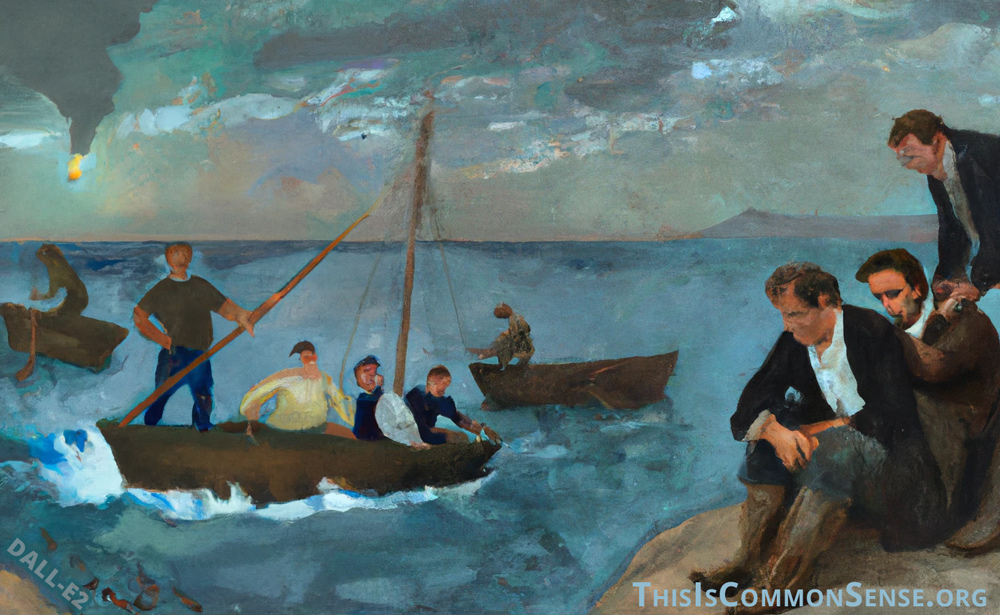
In a new documentary, The Broken Boys of Kenosha: Jacob Blake, Kyle Rittenhouse, and the Lies We Still Live, Oldham and Montz present “7 sacred tenets” of the race narrative advanced by the media that were verifiably false.
Those bogus beliefs “inspired thousands of protesters to descend on Kenosha” so that the city was “incinerated by a lie,” leading to 17-year-old Kyle Rittenhouse’s infamous visit to protect people and property, wherein he shot three men, two fatally . . . in self-defense.
Yet, the filmmakers don’t stop there; they offer “a deeper story.”
“Burn away the media-manufactured fiction about Jacob Blake and what do you see?” asks Montz. “You see a bad man,” he acknowledges, “but you ought to also see an abandoned boy.”
Montz calls Jacob Blake “just one tiny data point in a mass trend” of “an unspoken catastrophe . . . the explosion in the number of boys who grow up without dads.” One of every three Americans boys is growing up without a father in the home.
Blake was hardly alone — Rittenhouse and both assailants he killed were were also fatherless.
“The thing that actually correlates most closely to whether a kid is going to go into a life of crime,” former Attorney General Bill Barr points out, “is whether or not they had a father who was involved in their lives.”
The moral plague that follows — of “unanchored” men — is a problem government seems mostly to have exacerbated. Only we dads can solve it.
This is Common Sense. I’m Paul Jacob.
Illustration created with DALL-E2
—
See all recent commentary
(simplified and organized)
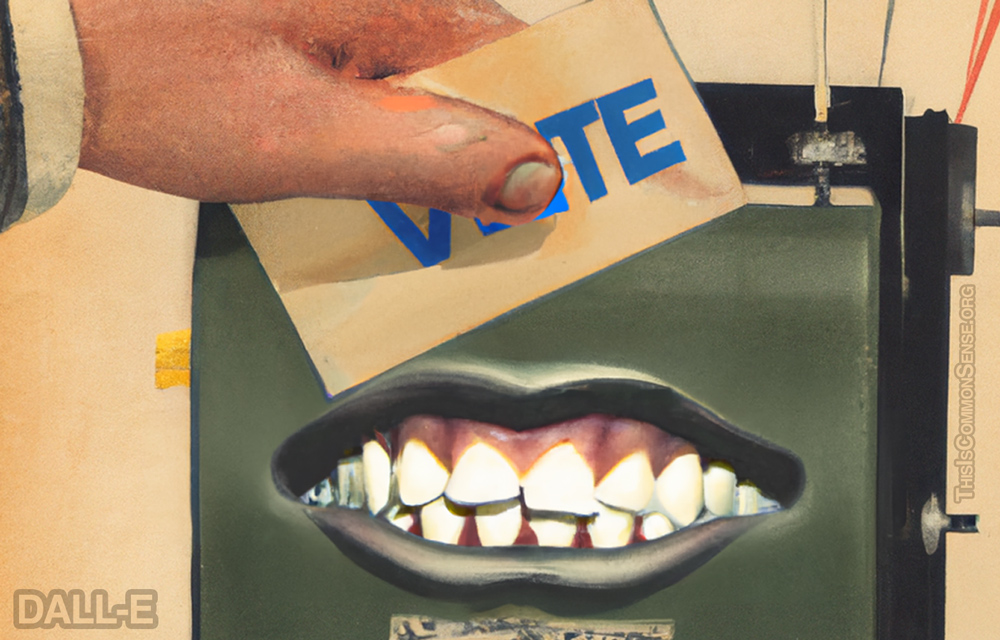
At least, that’s my opinion.
It’s also the view of the Democrat-controlled General Assembly.
Plus, it’s the preference of the state’s Republican Governor, as well as what the State Election Board wants to do “[a]fter a primary cycle plagued by long delays arising from counting a surge of mail-in ballots.”
Accordingly, you might surmise that when the Maryland Court of Appeals recently agreed with a lower court that the Election Board was A-OK to count mail-in ballots early, before the election, I would applaud their ruling.
Instead: the Bronx cheer.
This decision undercuts something much more important than ballot-counting speed and efficiency. It destroys the rule of law.
There is a constitutional method for repealing or changing laws on the books, and in fact, as The Washington Post explained,“State lawmakers tried to change the law during this year’s legislative session when they passed a bill that would have permanently removed the provision. But, Gov. Larry Hogan (R), who said he supported counting mail-in ballots early, vetoed the bill, citing other concerns with the legislation.”
Thus, the state’s representative political process spoke, for better or worse. It may be “an outdated law,” as The Post charged, but if it isn’t violating anyone rights, it should not be jettisoned by a judge for the government’s momentary convenience.
Government officials should be required to follow the law, when as here they can, until changed.
Not merely do whatever they want to.
This is Common Sense. I’m Paul Jacob.
Illustration created with DALL-E
—
See all recent commentary
(simplified and organized)

She marshaled this self-righteousness in response to media inquiries as to why, as The Times-Picayune/The New Orleans Advocate reported, “Cantrell has charged the city of New Orleans $29,000 to travel first- or business-class instead of coach.”
Mayor Cantrell defiantly refuses to pay back “the exorbitant fees” she ran up “for the upgraded tickets, including an $18,000 first-class trip to France over the summer.”
But that’s precisely what City of New Orleans policy demands of her. “Employees are required to purchase the lowest airfare available,” it clearly states. “Employees who choose an upgrade from coach, economy, or business class flights are solely responsible for the difference in cost.”
Yet, her excuse for upgraded jet-setting is priceless.
“As all women know, our health and safety are often disregarded . . .” Cantrell offered. “As the mother of a young child whom I live for, I am going to protect myself by any reasonable means in order to ensure I am there to see her grow into the strong woman I am raising her to be,” she continued. “Anyone who wants to question how I protect myself just doesn’t understand the world black women walk in.”
Hmmm. Just how much safer is it in the airplane’s high-priced seats?
Plus, a pity that the mayor didn’t show any consideration for those fearful souls flying with her. One of “Cantrell’s flights cost nine times that of an aide who accompanied her but flew in coach.”
There is good news, however. A recent poll of registered voters shows a majority (55.4%) support recalling Queen — er, Mayor Cantrell.
This is Common Sense. I’m Paul Jacob.
Illustration created with DALL-E
—
See all recent commentary
(simplified and organized)