nannyism

...now browsing by category


The Skinny on Fat

Tuesday, May 4th, 2010

Many Americans are overweight or even obese. I’m one of them.

You probably are, too. After all, the media keeps ominously hyping that nearly two-thirds of us fit these categories. Of course, being “overweight” and being “obese” are not exactly identical.

A plurality of 37 percent of us are overweight. Only 27 percent are obese. Said another way, 73 out of a hundred Americans are not obese.

Problem solved?

Not exactly. Obesity is still a very real health and well-being problem for a great many folks.

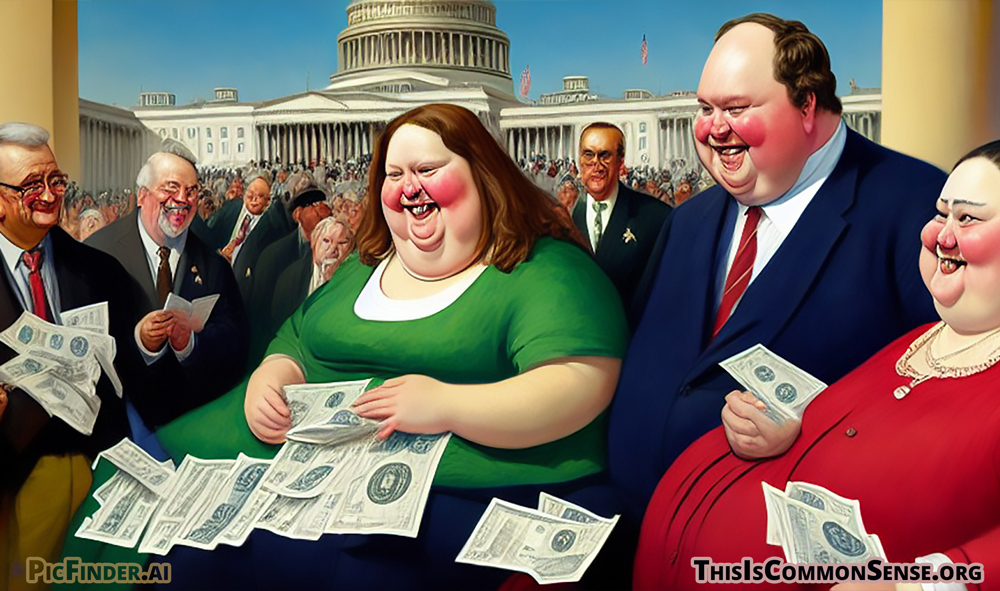
Plus, obesity provides politicians with a new reason to take and spend more tax money. The city council in Washington, DC, wants to spend $23 million additional dollars over the next four years to fight obesity. The program will be financed through a proposed one-cent per ounce soft drink tax. Funny, though, the soda tax will bring in $16 million a year, more than the $10 million needed for fighting the fat.

In the spirit of slimming down, you might think the city could have found something to cut to afford the new program. But politicians aren’t prepared to take their own advice.

I need to lose some weight. I figure I’ll exercise more, and stop allowing myself so many calories. The cost to me? Nothing. Heck, I’ll save money.

The cost to you? Not one thin dime.

Care to join me? Let’s call it the Starve-a-Politician Diet.

This is Common Sense. I’m Paul Jacob.

Unhappiness Is a Drawn Gun

Tuesday, August 25th, 2009

Dear Reader: This “BEST of Common Sense” comment originally aired on September 20, 2007. The growing use of zero-tolerance policies — especially having anything to do with guns — is the opposite of common sense. Mass insanity may be more popular these days, but I still prefer common sense. —PJ

There’s the real world, and there are representations of it.

I draw a picture of, say, a gun. That picture is of a gun; it is not itself an actual gun. It’s just, well, a doodle.

This being the case — that doodles differ from real threats — then why was a 13-year-old boy near Mesa, Arizona, suspended from school?

He drew a gun . . . on a piece of paper. He didn’t point it at anybody. He made no hit list. He didn’t say “Bang.” No one even got a paper cut.

But school officials treated it as a threat, lectured his poor father on the shooting at Colorado’s Columbine High School, and suspended the lad.

The district spokesman insisted that the doodle was “absolutely considered a threat.” But somehow, knowing that this student was suspended, I’m not feeling any safer.

If our teachers and administrators can’t distinguish real threats from doodles — doodles most boys do, doodles I drew when I was a boy — then what are they teaching the kids? To overreact to everything? To not be able to distinguish small problems from big ones? To treat every symbol or representation as the real thing?

It’s elementary: The map is not the actual territory; the representation is not the thing represented.

You’d think, then, that teachers would be trying to impart (not erase) that notion from the minds of students.

This is Common Sense. I’m Paul Jacob.

Rubbing Salt Into the Wound

Thursday, April 16th, 2009

New York City Mayor Michael Bloomberg finagled a way around the city’s two-term limit on mayoral service, and is now running for a third term.

As if to rub it in, he’s attacking our use of salt.

Bloomberg has simply declared that the city is starting a “nationwide” effort to pressure the food industry to decrease salt use.

Which is more audacious, making New Yorkers’ salt shakers the city’s business, or foisting this intrusion onto the rest of the country?

This would have been a strawman example — a reductio ad absurdum — a generation ago. Back then, when some of us objected to, say, regulation of cigarettes, arguing that next government would be regulating the salt on our French Fries, earnest nanny-state proponents would sniff. No. They wouldn’t do anything that absurd.

Today, Thomas R. Friedman, Bloomberg’s man at the city health department, claims that if restaurants followed the New York City government prescription, they would in effect “lower health care costs and prevent 150,000 premature deaths every year.”

Is he right? John Tierney, writing in The New York Times, asserts that this “prediction is based on an estimate based on extrapolations based on assumptions that have yet to be demonstrated despite a half-century of efforts.”

Healthy or not, my salt intake is my business. And maybe my wife’s. Not New York City supreme ruler Michael Bloomberg’s.

This is Common Sense. I’m Paul Jacob.

The Boomers’ Bust

Wednesday, November 12th, 2008

Remember when Bill Clinton ascended to the presidency? There were hurrahs. At last the Baby Boom generation had its own president!

We’ve gone through another Baby Boom president, and now we — and I’m talkin’ ’bout my generation, here — have our very own economic bust. Call it the Boomers’ Bust.

John Kass, writing in the Chicago Tribune, notes how different things look for Boomers, now. “In the ’70s,” Kass writes, “the slogan was ‘Do your own thing.” But today’s slogan might be ‘Washington, please save us.’”

Kass attributes some of the difference merely to age. When we were young, we took risks. Now that we’re older, we simply want to keep our houses and our cars and our TV sets, and our retirement plans.

The ominous marker in all this is the transfer of power. In our desires, demands, for security, we’ve given up a lot. Kass says we are giving up “liberty for all” and exchanging it with “power in the hands of a few.”

We can see it is who gains most: people and corporations on the inside track. But, as Kass points out, look who loses: “The casualty will be the entrepreneurs, those on the outside. . . . Such men and women will be on the outside for decades now.”

Since it was entrepreneurs who accomplished the most enduring good during the last 40 years, this will be tragic.

This is Common Sense. I’m Paul Jacob.

Jerry Brown’s Latest Trip

Tuesday, September 16th, 2008

Some politicians are loathe to allow freedom of action even when they’re going out of their way to allow freedom of action.

California Attorney General Jerry Brown doesn’t want the federal government to harass patients who use medical marijuana, or to harass those who provide it. To implement this laissez-faire policy, Brown wants to make darn sure that any businessmen who provide cancer patients with marijuana are the ones who get raided and arrested.

What’s going on?

Cannabis for medical use has been legal in California since 1996, when voters passed Proposition 215. The federal government has not been playing along, however.

To clarify things, Attorney General Brown has issued an 11-page guideline to help “legitimate patients” avoid being arrested. The guidelines also confirm the legality of medical marijuana co-ops. Brown hopes that under the new guidelines patients will steer clear of the unapproved dispensaries.

Who is an unapproved provider? Anyone who actually makes money selling medical marijuana. Supposedly, it’s okay for a cancer patient to ease his pain with the plant, so long as there is no economic incentive for anyone to help him ease it. It must be done by nonprofit co-operatives.

Bruce Mirken of the Marijuana Policy Project doesn’t agree that socialist medicine is good, capitalist medicine bad. “Last I heard,” he says, “Walgreens isn’t a charity.”

He’s right.

This is Common Sense. I’m Paul Jacob.