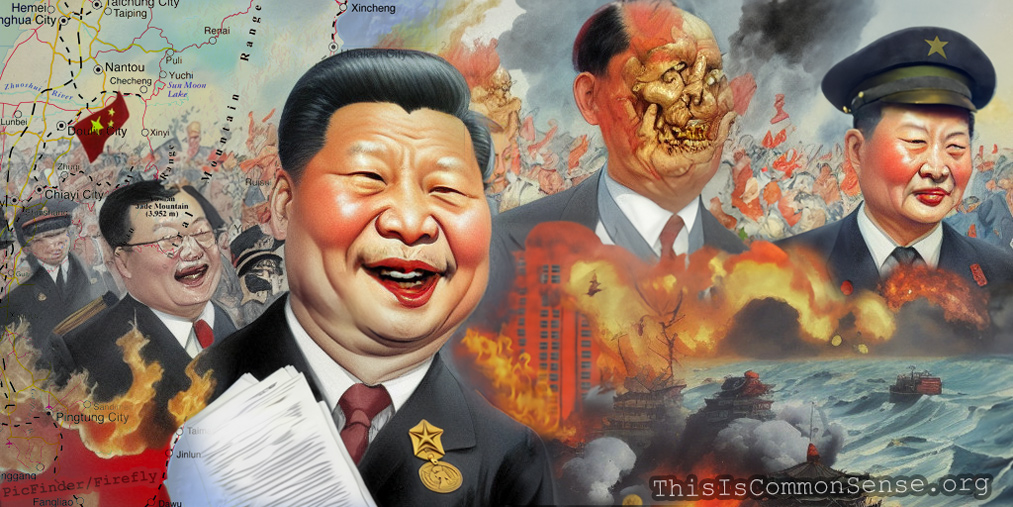
China

...now browsing by tag


Apple Abjectly Apologizes for Arrogance

Tuesday, April 2nd, 2013

Apple is a huge company, selling gadgets around the world. One of its biggest markets turns out to be China, which is also a supplier of many components. And working within a quasi-capitalist/quasi-post-communist dictatorship does have its problems.

Yesterday we learned that Apple’s head honcho, Tim Cook, has openly apologized to Chinese consumers.

He did it under pressure . . . from China’s state-run media.

The non-paranoid way of looking at this is that Apple has fallen down on the job of Chinese consumer support. The company’s 17,000 outlets, including eleven Apple-branded stores, just do not service consumer complaints well enough.

This may be true.

But the pile-on by the media looks a little different than, say, the piling-on by America’s media against successful companies here. It has the odor of concerted plan, “commandment from on high.”

And it is well known that China — which tries to plan its economy as much as humanly possible, with the iron fist of totalitarian law — when it gets really serious, gets serious indeed.

So, Tim Cook’s abject apology echoes not so much Apple’s rare apologies in America, but the apologies made by targets of China’s Cultural Revolution, a generation or two ago, at least if the BBC has it right:

State broadcaster CCTV and the state’s flagship newspaper, People’s Daily, had portrayed Apple as the latest Western company to exploit Chinese citizens.

Last week the paper ran an editorial headlined: “Strike down Apple’s incomparable arrogance.”

Even Apple’s (or Microsoft’s) critics in the West don’t sound that strident.

For the record, I have complaints with all gadgets, all systems, all suppliers. I can truly be nonpartisan on this.

And this is Common Sense. I’m Paul Jacob.

What Goes Up, China Edition

Thursday, November 22nd, 2012

Skyscrapers inspire.

Sometimes they inspire shudders.

I am an admirer of such neo-Babels, and you can’t find a better Schelling point for New York than the Empire State Building. Civilization’s highest erections symbolize something good about humanity.

And yet, I wonder about the latest Chinese engineering effort, Sky City, to be built in Changsha in record time, 90 days.

It’s supposed to house over 31,000 people, contain hotels and restaurants and schools and shops, too, and tower up 163 floors to a height of 2,749 feet.

How could such a thing be so quickly constructed, and still be safe?

Cheating.

Well, not really. It’s prefab. Much of the work has already been done. Building it will be a job of putting pre-fabricated pieces together. The company responsible for the effort has had some success on prefab buildings before, and . . .

The whole thing still sounds a tad hubristic. I wish the builders (and inhabitants) the best, but, even if it succeeds, there’s an ominous aspect to the whole project, if economist Mark Thornton’s theory about new-building skyscrapers has any truth to it. Tall buildings are built when people are optimistic. People are most optimistic during booms. Booms — at least inflationary booms — yield to busts, and many of the major economic depressions have been marked by unfinished or just-finished record-book skyscraper projects.

Does Sky City signal a Chinese bust coming soon?

It may. For the story of our time might be this: China is to America, now, what America was to Great Britain in the 1920s and ’30s. Similar monetary policies and bailouts.

And the loaning nation doesn’t get off free. At least, we didn’t in the decade in which the Empire State Building was finished.

This is Common Sense. I’m Paul Jacob.

China Syndrome, 2012

Monday, October 8th, 2012

The two major presidential candidates, incumbent Obama and challenger Romney, must spend their final weeks of the campaign appealing to

  1. Members of their respective parties disappointed enough to stay home on election day — or vote the dreaded “Third Party” ticket;
  2. Independent voters apt to find something distasteful about both candidates;
  3. The apathetic and the uninformed.

How to appeal to all three groups simultaneously? Well, go for the old standby: fear and hatred of foreigners.

This year, it’s the Chinese.

Romney started the China-bashing by calling our Chinese trading partners “cheaters.” Apparently he is much vexed about how the Chinese don’t respect established intellectual property rights, “stealing” our technology, “everything from computers to fighter jets.” Of course, this mainly happens after “we” set up manufacturing plants for that technology there. He charged that President Obama has not deigned to “stand up to China.”

Earlier, he had accused China of manipulating its money in its favor. He seems to have dropped that, perhaps out of embarrassment — our own Fed’s monetary manipulations, after all, dwarf China’s.

The Obama campaign responded by avoiding the intellectual property issue just as Romney now avoids the monetary one, calling Romney himself a “cheater.” You see, in his Bain Capital days, Romney invested in firms that relocated jobs to “low wage countries like China.” Romney, we are told, has “never stood up to China.”

By which is meant: Romney engaged in globalism and opposed protectionism.

Is Mr. Obama really suggesting that prosperity will come if we shrink from global competition and enact barriers to international trade in goods and services?

The biggest problem the U.S. economy faces isn’t Beijing; it’s Washington.

This is Common Sense. I’m Paul Jacob.

Moving to China?

Tuesday, February 21st, 2012

Venture capitalist Eric X. Li, in an op-ed for the New York Times, “Why China’s Political Model Is Superior,” credits the 1989 Tiananmen Square massacre with producing the “stability” that “ushered in a generation of growth and prosperity.”

As for America, Li explains that our problem is an “expanded” political franchise, “resulting in a greater number of people participating in more and more decisions.”

“Elected representatives have no minds of their own and respond only to the whims of public opinion as they seek re-election,” Li informs, and “special interests manipulate the people into voting for ever-lower taxes and higher government spending, sometimes even supporting self-destructive wars.”

Mr. Li points to California and predicts an American “future” of “endless referendums, paralysis and insolvency.”

But wait a second . . . Americans have no initiative or referendum powers at the national level. The people didn’t vote for this level of taxes, spending, war or massive debt – our elite political leaders did that. Too much control by the people? Hardly. Too little.

Note that the national government most affected by initiatives and referendums is Switzerland, which also has the world’s highest per capita income.

But, as Li tells us, “China is on a different path. Its leaders are prepared to allow greater popular participation in political decisions if and when it is conducive to economic development and favorable to the country’s national interests . . .” After all, “political rights . . . should be seen as privileges to be negotiated based on the needs and conditions of the nation.”

Those negotiations have left Nobel Peace Prize winner Liu Xiaobo in a Chinese prison.

This is Common Sense. I’m Paul Jacob.

Blame China

Wednesday, October 5th, 2011

The Great Depression was made “great” by government mismanagement.

Political action, first under Hoover and then under FDR, made things a whole lot worse. And it wasn’t just the Democrats’ misguided New Deal barrage of regulation, cartelization, and general anti-business central planning. The Hoover Era Smoot-Hawley Tariff, a huge Republican reassertion of high-barrier protectionism, crippled international markets and devastated the one industry it was meant, especially, to help: agriculture.

Protectionism is the idea that government should outrageously harm domestic consumers to “protect” domestic producers. And politicians, often thinking they must “do something” (i.e., “anything”) often feel the push to “save us all” by erecting barriers to trade. Since the crash of 2008, I’ve kept an eye on our Washington insiders, to see if they’d try to revive Thirties-style self-destructive nostrums.

Well, we’ve got a sighting.

Congress is gearing up for some anti-Chinese protectionism. An unfortunately bipartisan movement is festering there, saying China’s yuan is too valuable, making trade “unfair” for American producers. The Senate seems bent on passing the Currency Exchange Rate Oversight Reform Act.

But, according to Daniel Ikenson, what’s really going on is politics: Faced with “public approval ratings hovering in the low-to-mid teens, an embattled Congress is looking for plausible scapegoats for the dismal state of U.S. economic affairs.”

This is not sophisticated economic theory. It’s not conscientiously developed public policy.

It’s grasp-at-anything grandstanding.

And it could do a whole lot of harm.

This is Common Sense. I’m Paul Jacob.